
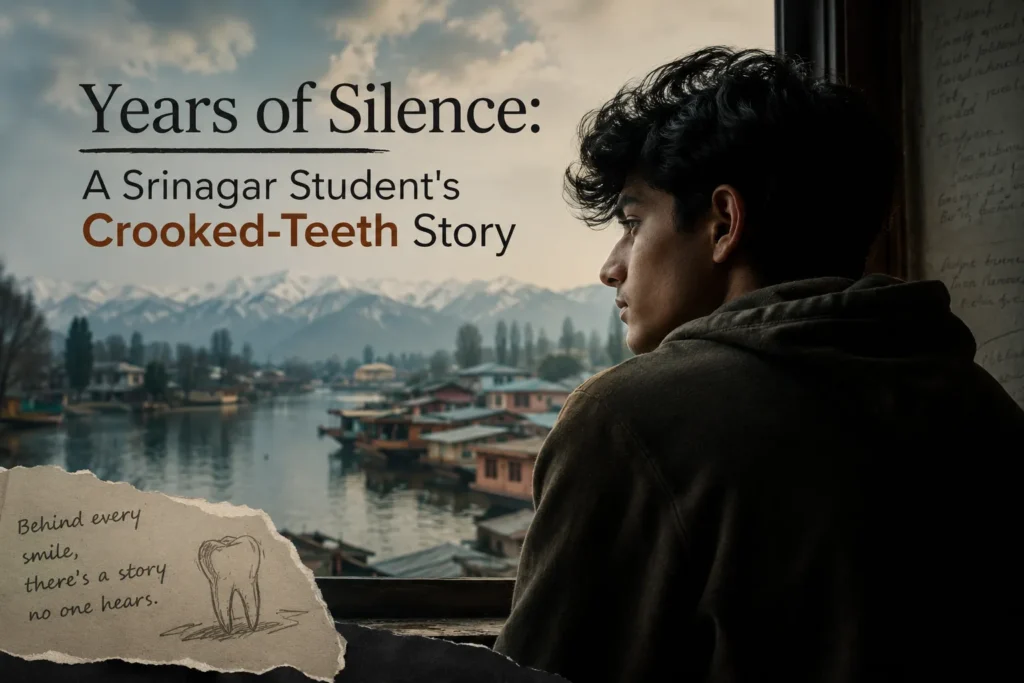
Owais still has the photo saved somewhere in his gallery. Fifteen batchmates lined up outside the college gate, arms slung over shoulders, sun hitting every face in the frame, and him, standing at the edge, lips pressed into something that was almost a smile but not quite. He’d been doing that since Class 9th. For years, that half-smile wasn’t a bad habit. It was just how Owais showed up in every photo, every classroom, every conversation where he might have to laugh out loud.
This is his story. It’s also, in some way, the story of a lot of people in Srinagar who’ve spent years quietly managing a smile they didn’t feel good about, long before they ever Googled “crooked teeth confidence” or wondered if braces were even worth it as a student.
The Smile He Stopped Showing
It started small, the way most of these things do. A cousin’s offhand comment at a wedding, “tere daant thode tedhe hain na”, said with a laugh, meant as nothing. Owais laughed along too. But he remembered it.
By the time he reached college, the habit was already automatic. He didn’t decide to stop smiling with his mouth open. It just happened, one photo and one classroom at a time, until it became who he was.
A few things became second nature to him:
- Closed-lip smiles in every single photo, even candid ones
- Sitting slightly angled in group pictures, so his face was never dead-centre
- Staying quiet during class discussions, even when he knew the answer
- Laughing with a hand near his mouth, almost without noticing he was doing it
None of this felt dramatic at the time. That’s the strange part about smile insecurity: it doesn’t arrive as one big moment. It builds in inches, until avoiding your own smile feels less like a choice and more like a personality trait.
By second year of college, Owais couldn’t actually remember the last time he’d laughed without thinking about his teeth first. The self-consciousness had been there so long, it just felt like the default setting.
Why Crooked Teeth Weigh Heavier Than People Think
By the time Owais was in eleventh grade, his friend circle had a nickname for him. “Dandaan” . Someone would say it at the tuition centre, someone else would say it during a cricket match, and it always got a laugh, including from Owais.
He laughed the loudest, actually. That was the trick.
Here’s something most people get wrong about boys who joke along with this kind of teasing: the laughing isn’t proof that it doesn’t hurt. It’s often the opposite. The louder and quicker the laugh, the more it’s doing to cover something underneath.
- If Owais had flinched even once, the joke might have stopped.
- Instead, he leaned into it, “haha dand khiss,” he’d say himself before anyone else could, and that made it safe territory for everyone.
- Nobody thought twice about repeating it, because he seemed fine with it.
That’s the quiet mechanics of any insecurity among young men in Kashmir. It rarely looks like sadness. It looks like banter, nicknames, self-deprecating jokes said just a beat too fast, and it works so well as a mask that even close friends genuinely believe there’s nothing underneath it.
There was something else going on too, something Owais didn’t have words for back then. Getting braces would have meant admitting the jokes had landed. Walking around with visible metal on his teeth wasn’t just a dental decision, it felt like putting up a sign that said, yes, this actually got to me.
For a lot of boys, that’s a harder thing to face than the crooked teeth ever were. Wanting straighter teeth felt like caring too much about how you look, and caring too much, especially for young men, gets read as weakness before it gets read as self-respect.
So Owais did what felt safer. He kept laughing along, kept his lips pressed together in photos, and told himself it genuinely didn’t bother him right up until the nights it clearly did.
The Real Reason He Didn’t Ask for Help Sooner
The idea of braces first crossed Owais’s mind properly in his second year of college, not eleventh grade. He noticed it while scrolling; a batchmate from another department had gotten them fixed over the summer, and the difference by October was obvious.
He didn’t say anything. He just sat with the thought for a while.
Then the excuses came, one after another, each one feeling more reasonable than the last:
- “Braces cost a lot, no?” he didn’t actually know the number, but he assumed the worst
- “How do I even bring this up at home?” his parents had never once mentioned his teeth, so raising it himself felt like drawing attention to something nobody else seemed to think was a problem
- “I’m not a kid anymore” Braces, in his head, were still something you got fixed at 13, not 20
- “People will ask questions,” and answering those questions meant admitting the “dandaan” jokes had actually mattered
That last one sat heaviest. Because underneath the money worry and the timing worry was the same thing from before: getting braces meant everyone would know he cared.
There’s a particular kind of pressure that lands on young men here around anything that looks like vanity. Skincare, haircuts, teeth, caring too visibly about your appearance gets you teased in a different way than the original teasing ever did. So Owais told himself it wasn’t worth it, packaged as practicality, when really it was protection.
He never once asked his parents what it would actually cost. He’d built the whole case against it in his head, using numbers and assumptions he’d never checked because not asking meant he never had to hear a “yes,” and never had to actually go through with it.
The Day That Changed Things
It happened at his cousin’s mehendi function, of all places. Someone pulled him in for a group photo with the groom’s side, and right as the camera clicked, a distant relative leaned over and said it loud enough for six people to hear, “Tala ye Dandan sozyun path kun”, “Send this weird teeth guy to the back”.
Everyone laughed. Owais laughed too, on reflex, the way he always did.
But that night, looking at the photo someone had already uploaded, something was different. He wasn’t in the group shot at all. He’d stepped back before the second click, out of the frame entirely, without even realising he’d done it.
That was the part that actually scared him. He hadn’t just hidden his smile anymore, he’d started hiding himself.
A few days later, he brought it up with Bilal, a close friend from his hostel block who’d gotten his own teeth fixed the year before. Owais expected the usual questions like why now? Is it that serious? Are you sure? But Bilal just said one thing.
“Bhai, Dand Woat jaake deakh.”
Bilal had gone to Dandwoat’s Zewan clinic himself, and what stuck with Owais wasn’t some polished pitch, it was how casually Bilal talked about it. No embarrassment in his voice at all, as it had just been a normal appointment and nothing more.
He still hadn’t decided anything by the next morning. But something about seeing himself step out of that photo frame stayed with him all day, so that evening, after dinner, he found himself still sitting at the table instead of getting up like usual.
His father was stacking plates. His mother was scrolling through something on her phone. Owais almost let the moment pass; it would have been easy to. Instead, he said it plainly, without building up to it: “Mumma, mein apne daant theek karwana chahta hoon.”
Nobody reacted the way he’d rehearsed in his head. His father just looked up and asked, “Kab se soch rahe ho?” His mother asked if it would hurt. Neither of them asked why now, or brought up any of the jokes he’d assumed they’d somehow known about all along.
That was the part that caught him off guard: how undramatic it was. Years of imagining this exact conversation, and it turned out to be five minutes at a dinner table, his father already asking which clinic he had in mind.
Owais still sat on it for another week after that. He looked up the Zewan location on his phone more than once, closed the tab, opened it again. Eventually he did the smallest possible version of the thing that scared him, he sent one message asking about a consultation, half-hoping nobody would reply too quickly.
Someone did. And two days later, for the first time since eleventh grade, Owais said out loud to someone outside his own head, to his parents first, and now to a stranger on the other end of a message, that he wanted his teeth fixed.
What Actually Happens When You Get Braces in Srinagar
Owais walked into Dandwoat’s Zewan clinic expecting a lecture. What he got instead was mostly questions: how long had this been bothering him? What did he actually want out of it? Had anyone looked at his bite before?
Nobody mentioned the word “dandaan” once. That alone made him relax a little.
Does Getting Braces Hurt?
This was Owais’s first real question, and he almost didn’t ask it. The honest answer he got: the fitting itself doesn’t hurt. There’s pressure and some soreness for the first few days after adjustments, especially early on, but it’s manageable discomfort, not the kind of pain he’d built up in his head.
He described it later as feeling like he’d bitten into something slightly too hard, on and off, for about a week. After that, it faded into the background of daily life.
How Long Does Treatment Usually Take?
There’s no single answer here, and anyone who gives you an exact number without examining your teeth first isn’t being straight with you. For Owais’s case, moderate crowding and no major bite issues, the estimate was in the range most people see for similar cases: roughly a year to a year and a half.
What mattered more to him was the shape of it, not just the length:
- First few months: the biggest visible shift happens here
- Middle stretch: smaller adjustments, less dramatic but steady
- Final phase: fine-tuning before the braces come off
Knowing the timeline in stages made it feel less like an open-ended commitment and more like something with a clear finish line.
What Do Braces Cost in Srinagar?
This is the part Owais had built the most anxiety around, and the part he’d never actually checked before that first visit. Prices vary clinic to clinic and case to case, depending on the type of braces and how much correction is needed, which is exactly why guessing at home does more harm than good.
His advice to anyone stuck where he was: don’t price it out in your head, ask for an actual consultation. Most clinics, Dandwoat included, don’t charge much for that first assessment, and it turns a vague fear into a real number you can actually plan around with your parents, if that’s the conversation you’re avoiding.
Types of Braces Available
He was given a straightforward choice, laid out without any pressure toward the more expensive option:
- Metal braces — the most affordable, most effective for complex cases, most visible
- Ceramic braces — tooth-colored brackets, less noticeable, slightly pricier
- Clear aligners — closest to invisible, best for milder cases, higher cost
Owais chose metal braces. Partly because his case needed the stronger correction, and partly because, for the first time, he wasn’t trying to hide the fact that he was doing this at all.
The Slow Adjustment, and the Moment It Actually Changed
Somewhere around month seven, something shifted that had nothing to do with his teeth.
Owais was sitting in the mess hall, mid-laugh at something stupid a friend had said, when he caught himself, not covering his mouth, not pulling back, just laughing. And in that half-second of noticing, he expected the old reflex to kick in. It didn’t.
He sat with that for a minute after everyone had moved on to a different conversation. Nobody had been watching him. Nobody had been grading his smile. He’d just been laughing, the way people do, without narrating it to himself afterwards.
That was the actual turning point, and it was neither a photo, nor a compliment, nor the day the braces came off. It was the quiet realisation that he’d stopped performing his own face for an audience that, most of the time, had never really been paying attention in the first place.
He thought back to “dandaan,” to the mehendi comment, to years of laughing along a beat too fast. None of it had actually been about his teeth, he realised. It had been about how much power he’d handed other people over something that was his.
Getting that power back took longer than the treatment itself. The metal brackets did their work in the background, slow, mechanical, patient. But the real shift was Owais deciding, somewhere in those quiet, unremarkable months, that his smile didn’t need anyone else’s approval to belong to him.
By the time the braces came off, he wasn’t relieved because people would finally see him differently. He was relieved because he saw himself differently, and that would have been true even if nobody else had noticed a thing.
If You’re Still Hiding Your Smile
If any part of Owais’s story felt familiar, here’s the part worth sitting with: this was never really about the teeth.
It’s about how much space you’ve let other people’s opinions take up in something that’s entirely yours: your own face, your own laugh, the way you show up in a photo. The jokes, the nicknames, the half-smiles held back at weddings, all of it was other people’s noise. You’re allowed to stop carrying it.
That shift starts as a decision, not a treatment plan:
- Notice the habits first: the hand near your mouth, the angled photos, the swallowed laugh. Naming them is most of the work.
- Separate the teasing from the truth: What people joke about isn’t a verdict. It’s just something they noticed once and never let go of.
- Decide it’s yours to fix, on your own terms: not because of what anyone said, but because you’re allowed to want something for yourself.
If you do reach a point where you want the physical part addressed too, Dandwoat’s Zewan and Baghat clinics are there for exactly that conversation with no lecture and no judgment about the years it took to get there. But that’s the smaller part of this. The bigger one already happened the moment you stopped needing anyone’s permission to smile.
Years of silence don’t end with someone finally noticing you. They end the day you stop waiting for them to.