
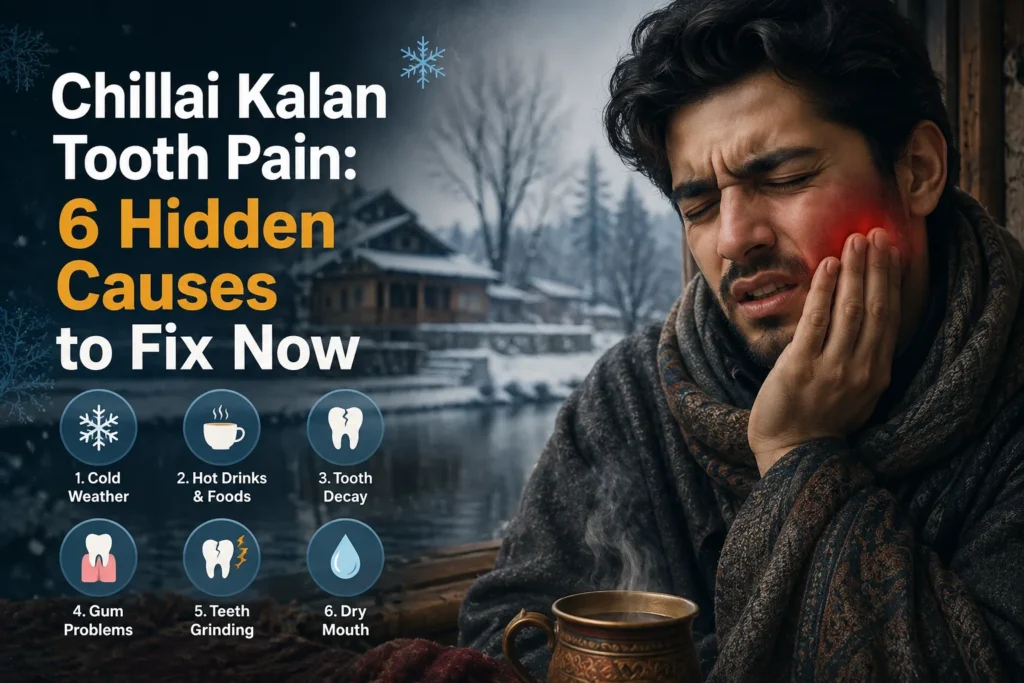
You take a sip of hot kahwa, and for one second, it’s the best part of your day. Then you step outside into the Chillai Kalan air, and a sharp jolt shoots through one of your back teeth like someone flipped a switch.
If that’s happened to you more than once this winter, you’re not imagining it. And you’re not alone.
Tooth sensitivity in winter is one of the most common complaints we see at Dandwoat’s Baghat and Zewan clinics every single Chillai Kalan. It makes sense once you think about what winter actually involves here, sub-zero mornings, bukharis and hamams running non-stop indoors, and three or four rounds of scalding chai just to get through the day.
Most articles on this topic are written for places where winter means a light jacket and 15°C. That advice falls apart the moment actual snow gets involved.
So here’s what we’re doing instead: six real, specific causes behind your winter tooth pain, explained the way a dentist would explain them in person, built around how Kashmir actually survives its coldest forty days.
What Is “Winter Tooth Sensitivity,” Really?
Here’s the short version: sensitivity isn’t a disease. It’s a warning light.
Every tooth has a hard outer layer called enamel, sitting on top of a softer layer called dentin. Think of enamel as the roof over your tooth; dentin is everything underneath it, packed with thousands of microscopic tunnels that lead straight down to the nerve.
When the enamel is intact, and your gums cover the roots properly, those tunnels stay sealed off. Cold air, hot tea, and sweet food can’t reach the nerve, so you feel nothing at all.
The problem starts the moment something exposes those tunnels: worn enamel, a receding gumline, a hairline crack. Cold or heat suddenly has a direct line to the nerve, and that’s the sharp, sudden zing you feel.
So when your tooth reacts to a blast of cold air the second you step out of a bukhari-heated room, that’s not “just winter.” It’s your tooth telling you something specific is already going on underneath and the six causes below will tell you exactly what.
6 Hidden Causes Behind Your Chillai Kalan Tooth Pain
Let’s go through them one at a time, starting with the biggest one — and the one almost nobody talks about.
1. The Kahwa-to-Cold-Air Thermal Shock
This is the biggest hidden cause here
Your teeth aren’t built to handle huge temperature swings back-to-back. Go from a steaming cup of kahwa straight into freezing Chillai Kalan air, and your front teeth can face a temperature difference of well over 100°F in a matter of seconds.
Enamel expands slightly when it’s hot and contracts when it’s cold, the same way most solid materials do. Do that enough times in one day, and tiny hairline cracks start forming on the enamel surface, cracks too small to see, but wide enough to let cold reach the nerve underneath.
Now picture a typical Kashmiri winter day: kahwa in the morning, noon chai mid-morning, another round in the afternoon, maybe a third by evening. Each cup is a small thermal shock. Each trip outside right after is another one.
The real issue isn’t the tea. It’s the whiplash. Sipping something hot and then immediately stepping into freezing air, talking, breathing through your mouth, and walking outside within a minute of your last sip is what does the damage, not the heat of the drink on its own.
2. Silent Enamel Erosion From Your Tea Habit
Kahwa and noon chai aren’t just warming you up. Every cup also gives your enamel a small, temporary workout.
Hot liquid softens the outer surface of your enamel for a short window afterwards, usually somewhere around 30 minutes. During that window, your enamel is at its most vulnerable to wearing down from brushing, biting, or even just talking.
Most people in Kashmir don’t have one cup of tea a day. Three or four rounds is normal, which means three or four vulnerable windows for your enamel, every single day, all winter long.
Here’s the specific habit to change: if you brush right after your morning kahwa, stop. Rinse with plain water instead, and wait at least 30 minutes before brushing. Brushing straight after a hot drink wears away enamel that hasn’t fully hardened back up yet.
There’s an interesting scientific wrinkle here too. Early lab research on green tea, the base of both kahwa and noon chai found that very hot water can cause micro-cracking in enamel, while the same tea at a cooler temperature actually seemed to protect it.
It’s one study, not a green light to drink lukewarm kahwa. But it backs up something dentists have suspected for a while: it’s less about what you’re drinking, and more about how hot it is when it touches your teeth.
3. Chillai Kalan Dry Mouth (Bukhari and Hamam Heat)
Saliva does more than keep your mouth comfortable. It constantly washes acid off your teeth and delivers minerals that repair tiny bits of enamel damage before they turn into real problems.
Winter cuts that protection down in two ways at once. Bukharis, hamams, and gas heaters all dry out indoor air significantly and dry air means less saliva production, even when you don’t feel thirsty.
At the same time, most people drink less plain water in winter simply because the cold makes them feel less thirsty. That’s a problem, because a cup of noon chai doesn’t fill the same role.
Noon chai has salt in it (that’s actually where the name comes from). It warms you up, but it isn’t replacing the water your mouth needs to keep saliva flowing normally.
A simple fix: keep a glass of plain water next to your kettle. Every time you make a round of chai, drink a small glass of water alongside it, not instead of it.
4. A Silent Crack or Cavity Finally Speaking Up
Sometimes winter tooth pain has nothing to do with winter at all. It’s just the moment an existing problem finally got loud enough to notice.
A small cavity, a hairline crack, or an old filling starting to loosen can sit completely silent for months. Without big temperature swings hitting the tooth, you might never feel a thing in warmer weather.
Winter changes that. Cold air and hot drinks both reach the nerve faster through a crack or a worn filling than they would through healthy enamel, so a problem that was always there suddenly feels brand new.
This is genuinely good news in one sense: the cold isn’t creating fresh damage here. It’s revealing something a dentist could likely have caught months ago with a routine check.
If your pain is coming from one specific tooth, rather than a general ache across several teeth, this is usually why. It’s worth an actual exam rather than waiting to see if it fades.
5. Gum Recession Hiding Under Your Phiran and Muffler
Tooth roots don’t have enamel protecting them. Gum tissue covers them instead, and when gums pull back even slightly, those roots are suddenly exposed to every temperature change your mouth deals with.
Gum recession happens gradually, usually from brushing too hard, grinding your teeth, or long-term gum inflammation. It’s rarely something you notice happening in the moment.
Winter makes it worse in a quiet way. Wrapped up in a pheran and muffler most of the day, you’re simply not checking your gumline in the mirror as often as you would in summer. Recession that’s been building for months goes unnoticed until the cold makes it impossible to ignore.
Press a finger gently along your gumline. Notice teeth that look slightly longer than they used to, or a rough edge where gum meets tooth? That’s recession, treatable, but it won’t reverse on its own.
6. Sinus Pressure Mimicking a Toothache
Not every winter “toothache” is actually about your teeth.
Your upper back teeth sit just below your sinuses, close enough that inflamed sinuses can send pressure straight down into the roots. Kashmir’s winter cold-and-flu season makes this far more common than most people realize.
Here’s how to tell the difference. Sinus-related pain usually affects several upper teeth at once rather than one specific tooth. It also tends to show up alongside other cold symptoms like a stuffy nose, pressure behind your cheekbones, and discomfort that gets worse when you bend forward.
A genuine dental problem, on the other hand, is usually traceable to one specific tooth, and it doesn’t care whether you have a cold or not.
If your toothache showed up at the same time as a cold and hits multiple teeth at once, treating the sinus congestion often clears the tooth pain right along with it.
Is This Just Winter, or Something More Serious?
Not every twinge means trouble. Most winter sensitivity is just your teeth reacting to a genuinely tough season, and it settles down on its own once you adjust a few habits.
But a few signs mean it’s time to stop guessing and book an actual exam. Here’s how to tell which camp you’re in.
This is probably just normal winter sensitivity if:
- The pain is a quick zing that fades within a few seconds of the cold air, hot tea, or sweet food leaving your mouth
- It affects several teeth fairly evenly, not one specific spot
- It’s been getting milder, not worse, since Chillai Kalan started
- Desensitizing toothpaste noticeably helps within two to three weeks of regular use
This is a red flag worth a same-week appointment if:
- The pain lingers for 30 seconds or longer after the trigger is gone, or turns into a dull throb on its own
- One specific tooth hurts, while the rest feel completely fine
- It wakes you up at night, or hurts when you bite down on something
- You notice swelling, a small bump on the gum, or a bad taste near one tooth
Here’s a simple way to test it yourself. Next time cold air or hot tea sets it off, count how long the pain lasts once the trigger is gone.
A few seconds and gone usually points back to the surface-level causes we just covered: thermal shock, worn enamel, dry mouth, or gum recession. Pain that lingers well past that, especially if it starts throbbing on its own afterwards, often means the nerve inside the tooth is actually inflamed, which is a different problem entirely.
That distinction matters because the fixes aren’t the same. One responds to toothpaste and time. The other one doesn’t get better no matter how long you wait it out.
How to Protect Your Teeth This Chillai Kalan
You don’t need to overhaul your entire winter routine to fix this. Most of these six causes respond to small, specific changes, not some drastic lifestyle overhaul.
Here’s exactly what to do, one cause at a time.
1. Switch to a toothpaste with potassium nitrate or stannous fluoride. These two ingredients are the actual difference-makers in “sensitivity” toothpaste, not just marketing language. Potassium nitrate calms the nerve inside the tooth directly, while stannous fluoride helps seal the exposed tubules, letting cold and heat through.
Give it two to three weeks of twice-daily use before judging whether it’s working, this builds up gradually, it’s not instant. For extra effect, smear a thin layer directly onto your most sensitive tooth before bed instead of just brushing and rinsing it away.
2. Fix your brushing, not just your toothpaste. Use a soft-bristled brush held at a slight angle to your gumline, moving in small gentle circles, not the back-and-forth scrubbing most people default to. Scrubbing is exactly what wears down enamel and pushes gums back in the first place.
And keep the 30-minute rule from earlier: rinse with plain water after your kahwa or noon-chai, then wait before you brush.
3. Breathe through your nose when you’re outside. This sounds too simple to matter, but it genuinely helps. Breathing through your mouth in Chillai Kalan air sends cold straight across your teeth with every breath; breathing through your nose warms that air first, so by the time it reaches your mouth, it’s lost some of its bite.
4. Keep a glass of water next to every round of chai. We covered why earlier: noon chai or kahwa doesn’t hydrate the way plain water does. Make it a habit: kettle goes on, glass of water comes out too.
5. Rinse with warm salt water when sensitivity flares up. Half a teaspoon of salt in a cup of warm water, swished for about 30 seconds, does two things at once: it’s mildly antibacterial, and the warmth (not hot, just warm) won’t shock a tooth that’s already irritated. Use it as needed, not as a replacement for your actual routine.
6. Don’t skip gum care just because it’s cold outside. Floss gently once a day, even when the bathroom is the last place you want to linger in winter. The gum recession we talked about earlier only gets worse when plaque builds up along a root that’s already exposed.
When Home Care Isn’t Enough: Professional Treatments
Most of what we’ve covered handles itself with a few weeks of consistent habits. But if you’ve already checked the red flags in the symptom test above and one or two apply to you, toothpaste alone probably isn’t going to close that gap anymore.
Here’s what actually happens next, mapped back to the specific cause behind it.
For thinning enamel: A dentist applies a concentrated fluoride varnish directly onto the affected teeth. It’s a much higher concentration than anything in a tube at home, and it seals exposed tubules in a single sitting rather than gradually over weeks.
For visible micro-cracks or worn spots: Dental bonding covers the compromised area with a tooth-colored resin. Once that resin is in place, cold air and hot tea have nothing left to reach the nerve through.
For gum recession: Mild cases usually just need a deep cleaning to stop things from progressing further. If the recession has exposed a significant amount of root, a gum graft covers it permanently — this isn’t as involved as it sounds, and it’s a one-time fix rather than an ongoing maintenance routine.
For a cavity or crack that’s already progressed: This needs an actual filling or crown, not a desensitising toothpaste papering over the problem. If the pain has moved into throbbing-on-its-own territory from our earlier test, that usually means the nerve itself is involved, and a root canal is what actually resolves it, not something that gets better by waiting it out.
One honest note on sinus pressure: if that’s genuinely what’s going on, there’s no dental treatment that fixes it. A proper exam should tell you that quickly, so you’re treating the actual congestion instead of getting talked into unnecessary dental work.
The fastest way to know which of these (if any) actually applies to you is a straightforward exam. Most of the time, it’s a lot smaller fix than people walk in expecting.
Why Chillai Kalan Is the Worst Time to Put This Off
Every cause we’ve covered is easiest to fix early before the season makes fixing anything harder.
Chillai Kalan doesn’t just bring cold. It brings snow heavy enough to slow down roads across Srinagar, including the ones leading to Baghat and Zewan.
A small problem today is a five-minute fix. The same problem in the middle of a snowstorm is an emergency you’re trying to solve on icy roads.
Take a small cavity or hairline crack that’s been sitting quietly for months. Left alone through the coldest stretch of winter, that’s exactly the kind of thing that turns into a real emergency, and it rarely picks a convenient moment to do it.
The smarter move is booking a check-up now, while the roads are still manageable. Not waiting until pain forces the decision for you in the middle of the worst weather of the year.
This isn’t about creating panic over routine sensitivity. It’s about timing something you’ll likely need anyway around a season that makes waiting genuinely harder, not easier.
Frequently Asked Questions
Why do my teeth hurt after drinking kahwa in winter?
That’s almost always the thermal shock from going from a hot cup straight into freezing air. Let your last few sips cool slightly, and avoid gulping the final mouthful right as you’re stepping out the door.
Giving your mouth even thirty seconds to adjust before it hits cold air makes a noticeable difference.
Is tooth sensitivity during Chillai Kalan normal, or should I be worried?
For most people, yes, it’s normal, a brief zing that fades in seconds and affects several teeth evenly. The line to watch for is pain that lingers well past the trigger, or one specific tooth acting up while the rest feel fine.
If that’s what you’re noticing, that’s not typical Chillai Kalan sensitivity anymore.
Can noon chai damage my teeth over time?
Not the tea itself; it’s the pattern around it. Three or four hot, salty cups a day, combined with reduced water intake, adds up to real enamel stress over a full winter.
You don’t need to give up noon chai. You just need the habits around it: rinse with water afterwards, wait before brushing, and keep a glass of plain water next to the kettle or samawar (if that’s what you use).
Why does cold air hurt more than cold water?
A sip of cold water touches your teeth for a second or two before it moves past. Cold air does the opposite; it flows across every tooth surface at once and keeps doing it with every breath you take outside.
That longer, more constant contact is why a short walk in Chillai Kalan air can sting more than an actual cold drink does.
How long does winter tooth sensitivity usually last?
With consistent care, the right toothpaste, gentler brushing, and better hydration, most people notice real improvement within two to three weeks. It should also keep improving as the weeks go on, not stay flat or get worse.
If it’s not budging after three weeks of actually sticking to the routine, that’s itself a sign something beyond surface sensitivity is going on.
When should I see a dentist for winter tooth pain in Srinagar?
Book a same-week appointment if any red flag from the symptom checklist applies to you, or if home care hasn’t helped after three consistent weeks. Don’t wait out the rest of Chillai Kalan hoping it resolves on its own.
Dandwoat’s Baghat and Zewan clinics are both easy to get to now, while the roads are still manageable.
The Bottom Line on Chillai Kalan Tooth Pain
Winter tooth pain in Kashmir isn’t one single problem. It’s usually a mix of things like thermal shock from your chai, dry indoor heat, gum recession you haven’t noticed yet, maybe an old cavity finally getting loud.
Here’s the one thing worth remembering above all the rest: Chillai Kalan doesn’t damage your teeth. It reveals what was already fragile.
That’s actually good news. It means most of this responds to genuinely small changes like a different toothpaste, thirty extra seconds before you brush, a glass of water next to your kettle.
And when it doesn’t respond to those changes, that’s your answer too. That’s not “just winter” anymore; that’s your teeth asking for an actual look, not another home remedy.
If any of the six causes above sound familiar, or you’ve checked off a red flag from the symptom list, don’t wait for the coldest weeks to pass. Dandwoat’s clinics in Baghat and Zewan are both open through Chillai Kalan, and a same-week check-up now is a lot easier than an emergency one later.
Your smile shouldn’t have to survive winter on its own.