
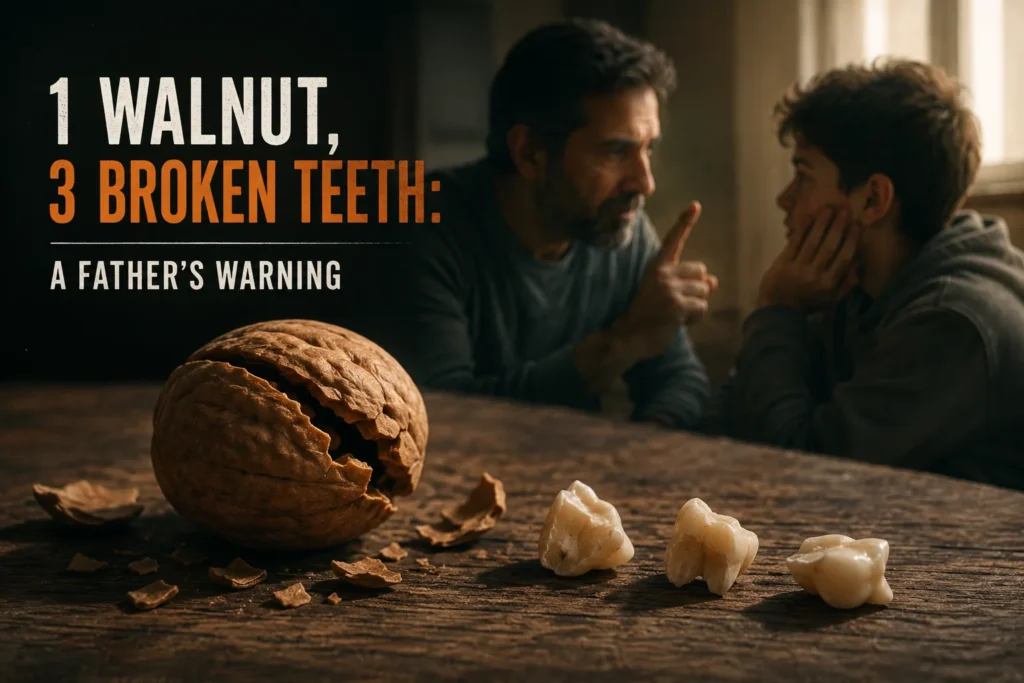
The walnuts were already cracked open on the table by the time anyone noticed something was wrong. Ghulam Rasool had done this a thousand times before, set a walnut between his back teeth, bit down with the same confident pressure he’d used since he was twelve years old, and waited for that familiar snap.
This time, the snap wasn’t the walnut.
He didn’t even register it as pain at first. Just a strange pressure, then a jagged edge his tongue kept finding. By the time he put the pieces together- three teeth, not one walnut shell- his kids had already stopped laughing at the table.
A Habit Passed Down, Not a One-Time Accident
Search “cracked a tooth on a walnut” and almost everything you’ll find is written like a fluke. A Thanksgiving dinner gone wrong. A ski trip snack that went sideways. One bad bite, once, by accident.
That’s not what happened to Ghulam, and it’s not what happens in most Kashmiri households.
Cracking walnuts with your teeth isn’t an accident here; it’s a habit taught on purpose. Fathers show their sons. Grandfathers do it at gatherings like a party trick, teeth against shell, no nutcracker in sight. Strong teeth become something to prove, not something to protect.
Nobody hands a child a nutcracker in that moment. They hand them a walnut, and something to live up to.
That’s what happened to Gulam that night. This isn’t a single dramatic bite gone wrong. It’s years of repeated pressure, normalised as harmless, treated as a mark of strength, right up until it isn’t.
What Actually Happened That Night
The pain didn’t show up right away. That’s the part Ghulam remembers most clearly now: how ordinary the rest of the evening felt.
He ran his tongue over the jagged edge a few times, decided it was probably just a small chip, and went back to the walnuts. Not the same tooth, obviously. But the same habit, minutes later, as if nothing had happened.
“It’s just a chip. It’ll be fine.” That thought is doing more damage in Kashmiri households than most people realise; it’s not because of carelessness, but because it’s exactly what a small crack is designed to make you believe.
By the next morning, one of the three teeth was sensitive to cold water. He brushed it off as nothing, the way most people do with a dull ache that doesn’t stop them from going about their day.
Three days later, that same tooth throbbed every time he chewed on that side. There was no sharp pain, just a dull, constant pressure that got worse by the hour instead of better.
That’s usually the moment people finally book an appointment. Not when the crack happens, but days later, once ignoring it stops being an option.
By the time Ghulam sat in the dentist’s chair, what could’ve been a same-day fix for a clean crack had turned into something more involved, because the days in between had given the crack room to worsen, and bacteria room to get in.
Why Walnuts Are Harder on Teeth Than They Look
A walnut shell doesn’t feel dangerous. It’s small, it’s dry, it doesn’t look anything like biting into a rock. That’s exactly why so few people take it seriously until it’s too late.
Here’s what’s actually happening in your mouth when you crack one with your teeth:
The pressure isn’t even. A walnut shell is irregular, thicker in some spots, thinner in others, with ridges that don’t sit flat against your tooth’s surface. When you bite down, that force doesn’t spread evenly across the tooth the way it would with something soft. It concentrates on a few small points, and those points take the full impact.
Your back teeth aren’t built for that kind of force, applied that way. Your molars are incredibly strong, but they are built to chew food that eventually yields. Cracking a hard, unyielding shell forces an intense and unpredictable strain on the tooth. And most of the damage doesn’t happen in one bite. This is the part almost no one explains properly:
- Each time you crack a walnut with your teeth, you’re not necessarily causing visible damage
- But you are creating microscopic stress lines in the enamel, too small to feel, too small to see
- Those stress lines don’t heal or disappear between walnuts
- They accumulate, bite after bite, gathering over months and years
A tooth that’s absorbed hundreds of these small stress events doesn’t need a particularly hard walnut to finally crack. It just needs one more bite added to years of bites that came before it. That’s why Ghulam’s teeth didn’t crack the first time he tried this at twelve years old, or the hundredth time, or even the thousandth. It’s why so many people who’ve cracked walnuts with their teeth for decades assume they’re simply “fine” right up until, without warning, they’re not.
The Damage You Don’t See Coming
If the damage builds up slowly, how do you know it’s happening before a tooth actually breaks?
Most of the time, you don’t. That’s what makes this different from other dental injuries.
A single dramatic accident- biting a fork, chewing a bone- usually comes with an obvious moment. You feel it happen. You know something’s wrong immediately.
Habitual walnut-cracking doesn’t work that way. The stress lines building up inside a tooth over years don’t come with symptoms. No sensitivity. No visible crack. No warning bite. The tooth looks and feels completely normal, right up until it isn’t.
That’s exactly what made Ghulam’s case so unsettling once the dentist explained it to him. It wasn’t one bad walnut that broke three teeth in one night. It was years of accumulated stress finally reaching a breaking point, and the walnut that night just happened to be the one that tipped it over.
A few signs that a tooth may already be carrying this kind of hidden stress, even without pain:
- A faint line visible on the tooth’s surface, especially under direct light
- Occasional sharp sensitivity when biting down at a certain angle, that comes and goes
- A tooth that feels “different” when chewing on that side, without a clear reason why
None of these on their own mean a tooth is about to break. But if you’ve been cracking walnuts with your teeth for years, and any of these sound familiar, that’s worth mentioning to a dentist before there are three teeth to fix instead of one.
What Treatment Actually Looked Like
Walking into the clinic that day, Ghulam expected to hear “we’ll pull the tooth.” That’s usually the fear that keeps people away longer than they should stay away: the assumption that whatever’s wrong is already past saving.
It wasn’t, for two of the three teeth. The third took a bit more work.
The first tooth had a clean, minor chip. This one was straightforward, smoothed and reshaped with dental bonding in a single visit. No injections, no follow-up needed.
The second tooth had a deeper crack, but the root wasn’t affected. This is where a crown came in: a cap placed over the tooth to protect what remained of it and restore its full function. It took two visits:
One to prepare and fit a temporary crown, a second a couple of weeks later to place the permanent one.
The third tooth was the one that had been throbbing for days. The crack had gone deep enough, and the delay had given it enough time, that the nerve inside was affected. That meant a root canal before a crown could go on top, the more involved option, and the one that could’ve likely been avoided with a same-day visit instead of a three-day wait.
Here’s the part worth sitting with: the severity of each tooth’s treatment tracked almost exactly with how long it had been ignored. The chip he’d noticed immediately and did nothing about needed the least work. The one that throbbed for three days before he came in needed the most.
That’s not a coincidence specific to Ghulam. It’s how cracked teeth generally behave: the earlier they’re seen, the simpler the fix.
Breaking the Habit Without Losing the Tradition
Here’s what Ghulam didn’t have to give up: walnuts. The habit he had to let go of wasn’t the walnut itself; it was cracking it with his teeth.
That distinction matters, because it’s usually the fear of losing something familiar that keeps people repeating a habit long after they know better. Nobody wants to feel like they’re abandoning a tradition their father taught them.
The fix here isn’t complicated, and it doesn’t ask anyone to change what they eat. A simple nutcracker, kept in the kitchen where the walnuts already are, does the same job your teeth were doing without years of hidden stress building up in your enamel.
A few small shifts that keep the tradition alive without the risk:
- Keep a nutcracker within reach, not tucked away in a drawer; the habit changes faster when the tool is just as easy to grab as biting down was
- Show kids the nutcracker, not the bite: if the habit gets passed down at all, pass down the safer version of it
- Treat pre-shelled walnuts as a real option, not a lesser one, especially for older family members whose teeth have already taken decades of wear
Ghulam still eats walnuts every winter, same as always. His kids still gather around the same table. The only different thing is what’s sitting next to the bowl now: a nutcracker, doing quietly what his teeth used to do the hard way.
FAQ
Can cracking walnuts with your teeth really damage them over time, even without pain?
Yes. Each bite creates microscopic stress lines in the enamel that don’t heal between walnuts. They build up silently over months or years, often with no pain or visible warning, until a tooth finally cracks, sometimes on a walnut no harder than any other.
What should I do if I think I’ve cracked a tooth on a walnut?
See a dentist as soon as possible, even if it doesn’t hurt yet. A same-day visit for a clean crack is often a simple fix: bonding or a crown. Waiting even a few days can let bacteria reach the nerve, turning a small fix into a root canal.
Is a small tooth chip from a walnut something I can ignore?
No. A chip that doesn’t hurt today can still be sitting on top of a deeper crack you can’t see. Sensitivity to cold, a dull ache when chewing, or a change in how a tooth feels are all signs worth getting checked before they turn into something bigger.
Final Thoughts
Ghulam’s teeth didn’t crack because of one bad walnut. They cracked because of a thousand small ones before: a habit that felt harmless for thirty years, right up until it wasn’t.
That’s the part worth remembering if you’ve been doing the same thing without a second thought. The damage doesn’t announce itself. It waits.
A nutcracker doesn’t cost you the tradition. It just means the next crack you hear at the table is a walnut shell, not a tooth.
If you’ve been cracking walnuts with your teeth for years, or you’re already noticing a tooth that feels a little different when you chew, don’t wait for the pain to get worse before you get it checked. A quick visit to DantWott now is almost always simpler than the one you’ll need later.