
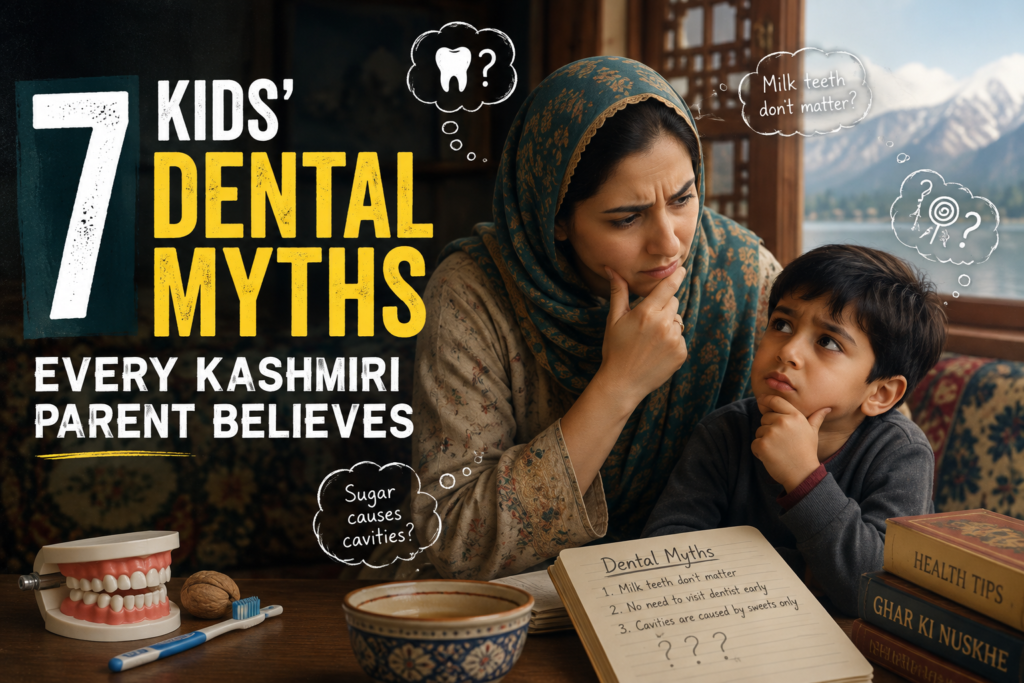
Dand Wott Srinagar breaks down seven common myths parents believe about children’s oral health, from baby teeth to bedtime bottles. Read this guide before your family’s next dental visit.
Your child’s grandmother might wave off a blackened baby tooth without a second look. She might say, “it is just a baby tooth that will fall out anyway.”
That single sentence, repeated in Kashmiri households for generations, is quietly setting kids up for pain, infections, and crooked adult teeth.
Here are the seven dental myths every Srinagar parent needs to unlearn, including the one keeping kids away from the dentist entirely out of fear rather than facts.
Most of this advice comes from love rather than carelessness. However, a lot has changed in pediatric dentistry and general family oral care since your parents were raising you.
As a family dental practice, any children’s dentist in Srinagar on our team will tell you the same seven myths walk through the clinic doors on repeat. They are usually explained by a well-meaning grandparent, an aunt, or a neighbor who swears by what worked for their kids decades ago.
Let us go through them one at a time, starting with why they took hold in the first place.
Why These Myths Spread So Easily
These myths did not come from nowhere. Most of them made a kind of sense once, or they came from genuine but outdated care.
For a long time, finding comprehensive family dental care or a dedicated children’s dentist in Srinagar was not as convenient as it is today. Waiting until a dental problem became impossible to ignore was not laziness. It was often just the reality parents were working with.
That reality hardened into advice, and that advice got passed down as fact. Hearing that a certain approach worked for someone else feels like solid proof, even when it is really just one outcome among many possible ones.
Pediatric dentistry and family dental care have advanced significantly. Today, routine checkups catch problems years before they become visible to a worried parent or grandparent. The guidance below is not about undoing bad parenting. It is simply about updating information that was genuinely the best anyone had at the time.
7 Myths Standing Between Your Child and a Healthy Smile
1. “Baby Teeth Don’t Matter, They’ll Just Fall Out”
This is the big one. It is the myth that causes the most damage by far.
Here is what that older advice misses. Baby teeth are not placeholders you can ignore. They are actively holding space for the permanent teeth growing underneath them.
When a baby tooth is lost early to decay, the teeth on either side do not just wait patiently for the adult tooth to arrive. They drift sideways into the empty gap.
By the time the permanent tooth is actually ready to come in, there is often not enough room left for it. That is how a single ignored cavity in a five-year-old turns into crowded, crooked adult teeth and years of braces later.
There is a second risk most parents never hear about. A badly infected baby tooth sits directly next to the permanent tooth developing in the jaw below it. Left untreated long enough, that infection can actually damage the adult tooth before it has even erupted.
2. “There’s No Rush, We’ll Start Visits at 3 or 4”
The actual guideline is much earlier than most parents assume. We recommend scheduling a visit by your child’s first birthday or within six months of that first tooth breaking through, whichever comes first.
That is not an arbitrary rule. Early decay starts as a small white or brown spot on the tooth long before it turns into an actual cavity. At that early stage, it can often be stopped or even reversed with the right care.
Wait until age three or four, and you have usually missed that window entirely. What could have been caught and fixed in one quick visit is now a filling.
There is a second reason early visits matter just as much. They teach your child that the dentist’s chair is a normal, unremarkable part of life rather than something to fear. That is a habit that pays off for the next fifteen years.
3. “As Long As Sweets Stay Away, Cavities Won’t Happen”
This is where most parents get genuinely blindsided because the real culprit usually is not candy at all.
It is the bottle or sippy cup at bedtime. Milk contains natural sugar, even without a single drop of added sugar. When it pools around a child’s teeth for hours overnight while saliva production naturally drops during sleep, that sugar has nothing stopping it from feeding decay-causing bacteria all night long.
Dentists actually have a name for this specific pattern. It is called early childhood caries, sometimes referred to as baby bottle tooth decay. It shows up almost the same way every time. The decay is concentrated on the upper front teeth since that is where the liquid pools longest during a bedtime bottle.
The actual fix is: If your child needs a bottle or sippy cup to settle down at night, make the last one water only. If milk is part of the bedtime routine, a quick wipe of the gums or a proper brushing right after closes that overnight window completely.
4. “Thumb-Sucking Is Harmless, It’ll Stop on Its Own”
For a toddler, this one is mostly true and not worth losing sleep over. Most kids drop the habit naturally somewhere between two and four.
The real question is timing rather than the habit itself. If thumb-sucking is still a strong, daily habit once permanent front teeth start coming in, the constant pressure can start pushing those new teeth outward. This usually happens around age five or six.
That is how you end up with an open bite. The front teeth do not meet even when the back teeth are together, or the child develops a noticeably narrowed upper palate. Neither reverses on its own once the permanent teeth have shifted.
The actionable takeaway is not to panic over a three-year-old sucking their thumb. Start paying attention once those first adult teeth begin arriving.
5. “My Child Will Be Terrified, Better to Wait”
This is the myth that quietly does the most harm because it is not really about facts. It is about fear, and it is the primary reason parents delay a visit even after they know better.
Here is what actually happens in modern family and pediatric dentistry. The first visit or two usually involves no drilling, no needles, and nothing invasive at all. It is a look, a count, and maybe a gentle cleaning. This often takes place with your child sitting in your lap the entire time.
Dentists use a simple technique called tell-show-do. We explain what a tool does, show it up close on a finger first, and then only use it once the child is not startled by it. It sounds small, but it changes everything about how a child experiences that first visit.
Waiting does not make a future visit less scary. It usually makes it more urgent, which means less time to build that trust gradually and more chance the first real visit happens during an actual toothache.
6. “Fluoride Toothpaste Is Dangerous for Kids”
This myth usually comes from a real fact that has been stretched way past what it actually means. Too much fluoride, swallowed repeatedly over years during tooth development, can cause mild white spotting called fluorosis. That part is true.
However, the amount used in a properly supervised brushing is nowhere close to that. For kids under three, that is a smear the size of a grain of rice. From three to six, use a pea-sized amount. At those doses, fluoride does the opposite of harm. It actively strengthens enamel and can even reverse early decay.
The actual job here is not avoiding fluoride. It is supervising the brush, using the right amount for your child’s age, and teaching them to spit rather than swallow.
7. “Braces Can Wait Until Every Adult Tooth Is In”
Orthodontists actually recommend a first evaluation by age seven. This is years before most kids have anywhere near a full set of adult teeth.
That is not because most seven-year-olds need braces. It is because that is the age when developing problems are easiest to spot. We look for crowding, a crossbite, or a jaw that is growing unevenly. We do this while the jaw is still growing and far more responsive to guidance.
Catching an issue at seven sometimes means simple, early intervention prevents a much longer and more involved treatment at fourteen. Wait until every adult tooth has arrived, and that window has already closed.
What an Actual First Visit Looks Like
Here is the part almost no one tells nervous parents. The first visit is not really about the teeth. It is about the child getting comfortable in the chair, and everything else comes later.
As a clinic treating the whole family, we understand that creating a welcoming environment for your little ones makes dental care easier for everyone. Most first appointments start with your child right in your lap instead of on a separate exam chair. There is no rush to change that.
The dentist typically begins with just looking and counting teeth. There is no drilling, no needles, and nothing that requires your child to sit still and endure something uncomfortable.
A few things you can expect:
- A soft brush or small mirror introduced slowly.
- A quick and gentle cleaning if your child is comfortable with it.
- A tell-show-do approach where the dentist explains a tool, lets your child touch or see it up close, and then uses it. We never skip straight to the doing.
That last part matters more than it sounds. A child who has seen the mirror and touched the brush is not startled when it shows up near their mouth.
If your child cries or squirms, that is expected rather than a failed visit. Our team builds the whole appointment around going at your child’s pace, even if that means the first visit is just a look and a wave goodbye.
A good first visit usually ends the same simple way. It ends with a countdown to the next check-in six months out, and a child who does not dread their next appointment alongside their parents.
Building Good Habits Early Without a Fight
Good dental habits do not need to be complicated. They just need to survive a tired weeknight, which is where most well-intentioned routines actually fall apart.
Brushing that actually works for small hands
Give your child a soft and child-sized toothbrush with a grip they can hold themselves, even if you are the one doing the actual brushing.
Until your child can reliably spit instead of swallow, usually around age six or seven, you are brushing their teeth rather than just watching them do it. Aim for two minutes twice a day using the fluoride amount matched to their age.
Fix snack timing instead of just snack choice
Constant grazing keeps a low level of sugar sitting on teeth all day with no break, even with relatively harmless snacks. Saliva never gets the chance to do its job of neutralising that acid.
Set snack times rather than providing open access to a snack drawer. This gives teeth real recovery windows between exposures.
Close the overnight bottle gap
This one is worth repeating from earlier because it is the single easiest fix on this list. If a bottle or sippy cup is part of your child’s bedtime routine, make the last one water.
If milk is non-negotiable at bedtime, a quick wipe of the gums or a full brushing right after closes that overnight decay window completely. Make sure to do this after the milk and not before.
None of these habits require willpower from a four-year-old. They just require the environment around them to make the healthy option the default one.
FAQ
When should my child first see a dentist in Srinagar?
By their first birthday or within six months of their first tooth coming in, whichever happens first. Waiting until age three or four usually means missing the window where early decay can still be caught and reversed instead of filled.
Is fluoride toothpaste actually safe for kids?
Yes, it is safe at the right dose for their age. Use a rice-grain smear under age three and a pea-sized amount from three to six. An adult should supervise so they spit rather than swallow. At that dose, fluoride strengthens enamel rather than harming it.
What if my child cries or refuses to open their mouth?
That is normal and not a failed appointment. Dentists who regularly work with children pace the visit around your child’s comfort. Sometimes that means the first visit is just a look and a count, with the rest building over future check-ins.
Do baby teeth really need fillings if they are going to fall out anyway?
Yes. Baby teeth hold space for the adult teeth growing underneath them. An infected baby tooth can pass that infection down to the permanent tooth still developing in the jaw.
Final Thoughts
None of these myths came from carelessness. They came from advice that made sense with the information available at the time, passed down by people who genuinely wanted the best for their kids.
A few updates change the outcome. Those updates include an earlier first visit, a simple fix to the bedtime bottle, and knowing that a scary dentist visit is not actually how it has to go.
If it has been a while since your family has seen a dentist, or your child has not had their first visit yet, there is no better time than now to bring them in for a calm and low-pressure look. We provide comprehensive care for adults, teens, and children under one roof. There is no pressure and no drilling on day one. It is just a chance for your child to get used to the dentist’s chair before they ever need to.